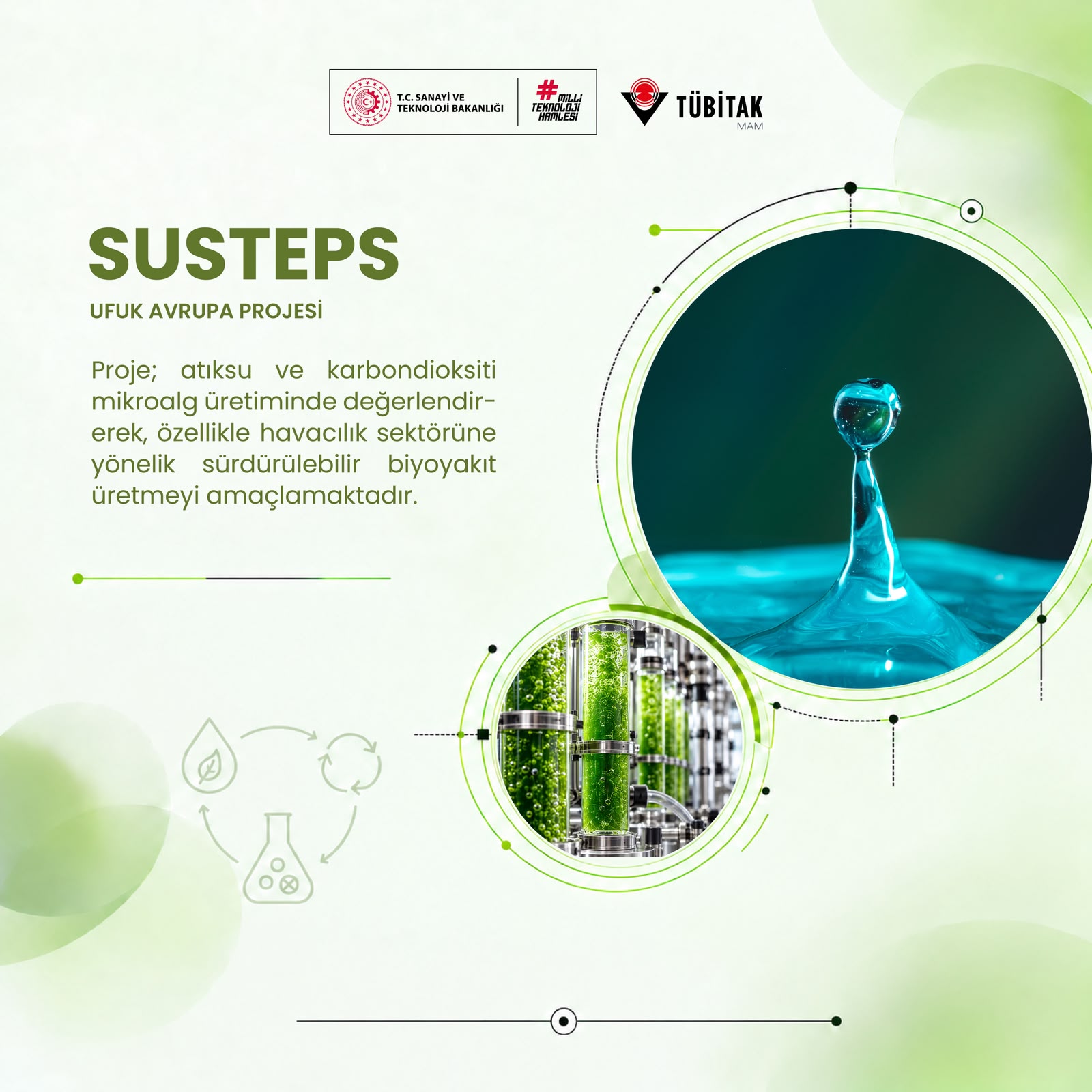
Led by TÜBİTAK MAM and carried out in collaboration with 11 international partners, the Horizon Europe project SUSTEPS is resolutely continuing its journey to develop high-yield SAF for the aviation sector by combining wastewater and flue gas with microalgae production.
As steps are taken toward net-zero emissions targets on a global scale, the need for environmentally friendly liquid fuels is growing day by day in sectors such as aviation, where electrification solutions remain limited. Supported under the European Union’s Horizon Europe Program and coordinated by the TÜBİTAK Marmara Research Center (TÜBİTAK MAM), the “Sustainable, Safe, and Competitive Energy (SUSTEPS) project—supported under the European Union’s Horizon Europe Program and coordinated by the TÜBİTAK Marmara Research Center (TÜBİTAK MAM)—addresses this need with an innovative technology chain based on circular economy principles.
As part of the project, which brings together an international consortium of 11 partners comprising research institutions, universities, and industry partners; wastewater and industrial carbon dioxide (CO₂) inputs are utilized in microalgal biomass production and converted into sustainable aviation fuel (SAF), with the goal of creating a low-carbon alternative to fossil jet fuel.
The Energy-Consuming Drying Stage Is Being Eliminated
While traditional biofuel production methods can compete with agricultural food crops and freshwater resources, microalgae offer an alternative biomass source that does not require farmland. However, due to microalgae’s high water content, drying them using conventional methods has, until now, led to significant energy consumption and increased costs in biofuel production processes. The project aims to overcome this obstacle through Hydrothermal Liquefaction (HTL) technology, one of the core technologies being developed in the SUSTEPS project. Wet algal biomass with high water content is converted directly into crude biofuel under high temperature and pressure, eliminating the need for an energy-intensive drying step. The resulting crude liquid product is purified of oxygen, nitrogen, and sulfur compounds through upgrading processes carried out with a catalyst and hydrogen, thereby being directly converted into high-quality advanced biofuel that meets aviation and diesel standards. Furthermore, by utilizing all byproducts generated in the developed process, resource efficiency is enhanced, thereby strengthening the technology’s economic and environmental sustainability.
A Circular Ecosystem Spanning from the Laboratory to Industry Is Being Established
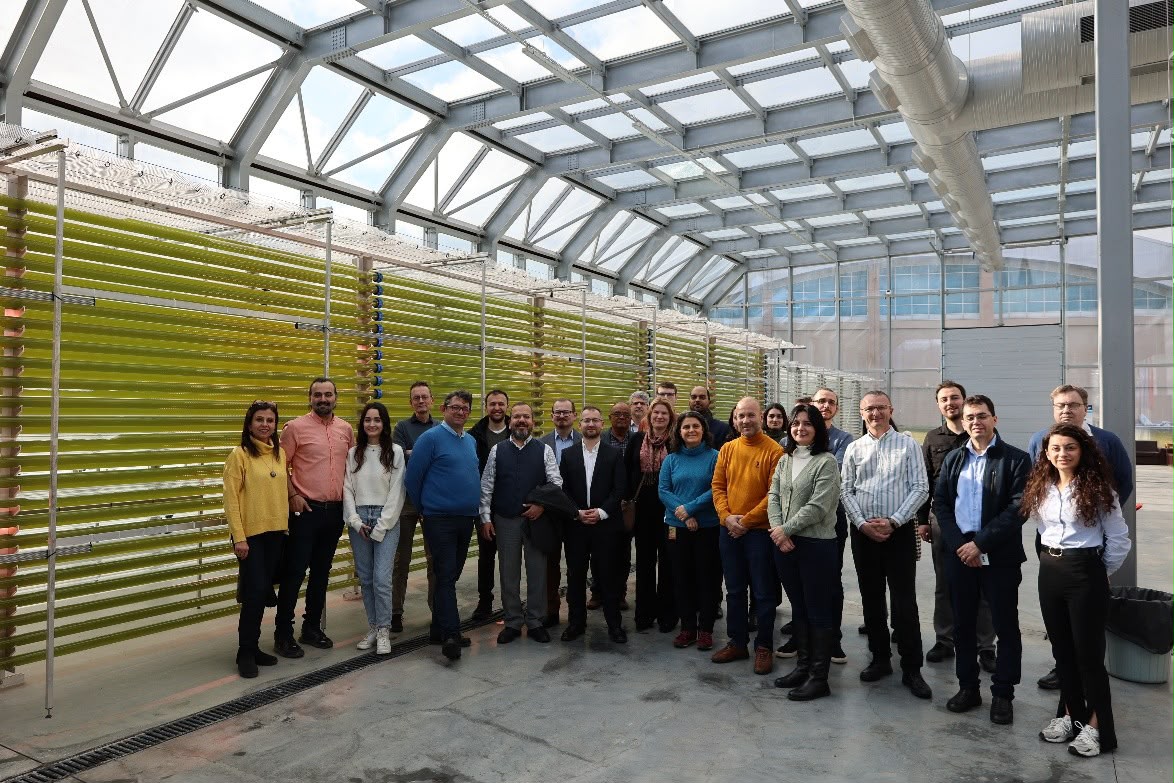
By also utilizing the byproducts generated in the integrated process developed under the SUSTEPS project, resource use efficiency is increased, thereby strengthening the technology’s economic and environmental sustainability. In line with this, ongoing research involves microalgae cultivation at a pilot scale with a capacity of 3,000 liters through the integration of flue gas and wastewater; high carbon conversion efficiency is targeted using continuously operating HTL systems, and solutions are being developed to address technical challenges hindering scale-up, such as salt separation at high temperatures. Additionally, by treating the aqueous phase generated after biomass conversion using membrane separation technologies, the aim is to recover and reuse water and valuable components. Within this integrated production chain, TÜBİTAK MAM carries out critical technological processes such as the catalytic upgrading of the crude biofuel obtained, improving fuel quality, and hydrogen purification.
All phases of the project, which is progressing according to a four-year work schedule, are being evaluated from economic and environmental perspectives through Techno-Economic Analysis (TEA) and Life Cycle Assessment (LCA) studies conducted under the coordination of TÜBİTAK MAM. Thanks to the support of these studies through Aspen-based integrated process simulations, the technical, economic, and environmental feasibility of scaling the technology to an industrial scale is demonstrated through a holistic approach.
With the completion of the SUSTEPS project, the goal is to convert waste and carbon dioxide into high-value-added, sustainable fuels through co-processing. The aim is thus to provide the industry with an integrated, advanced biofuel production platform whose technical and economic feasibility has been proven in the field.