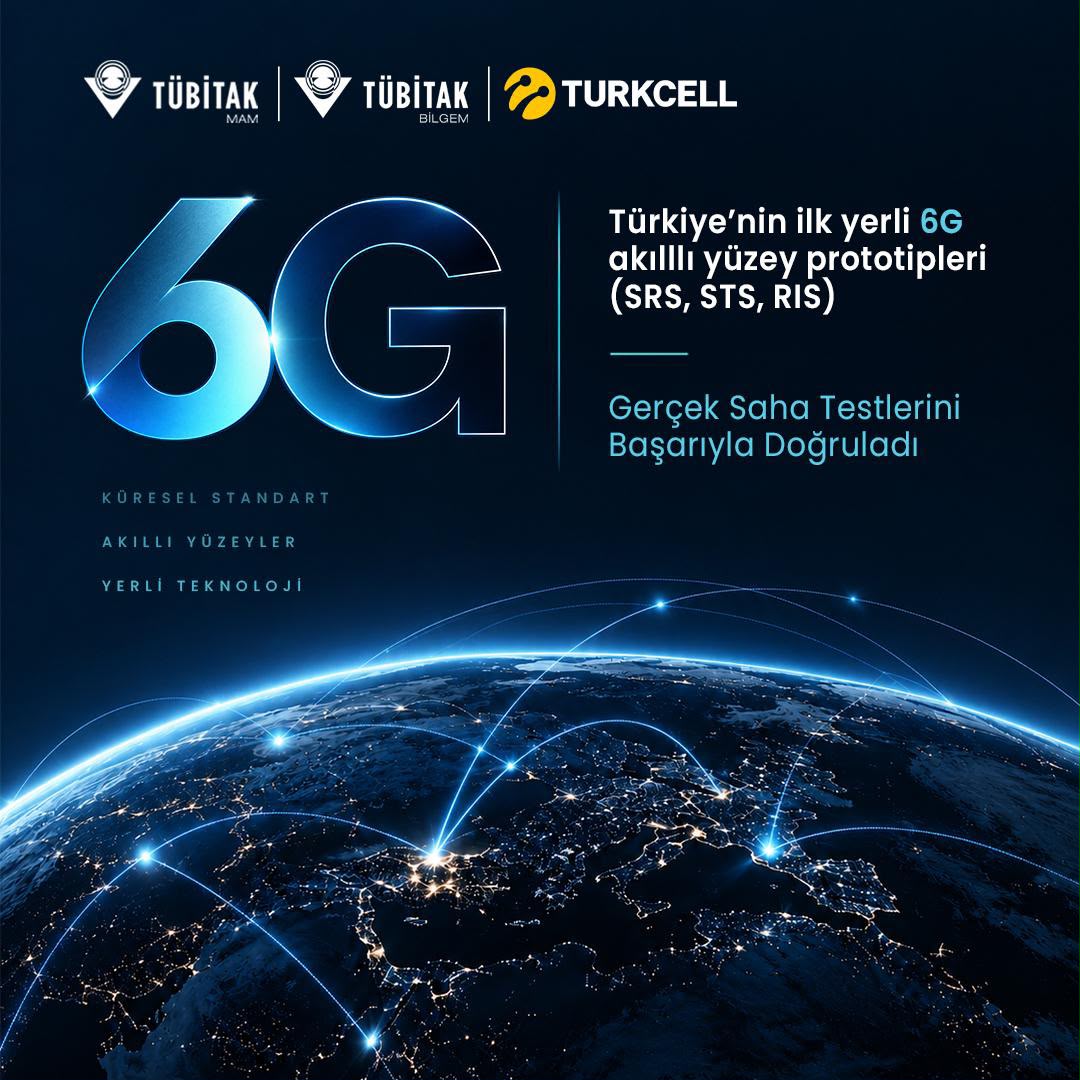
Under the leadership of Turkcell 6GEN.LAB and in collaboration with TÜBİTAK MAM and TÜBİTAK BİLGEM, domestically developed smart surface prototypes were successfully tested under field conditions for the first time.
R&D efforts focused on next-generation communication technologies in Turkey are continuing through comprehensive projects. In the field of smart surface technologies—considered one of the cornerstones of 6G networks—a significant milestone has been reached as the work has progressed from the laboratory phase to field applications. Under the leadership of Turkcell 6GEN.LAB, in collaboration with the TÜBİTAK Marmara Research Center (MAM) MİLTAL and Functional Materials Laboratory, as well as the TÜBİTAK Advanced Technologies Research Center for Information and Cybersecurity (BİLGEM) HİSAR Laboratory, were tested under real-world field conditions for the first time.
Signal Coverage Quality Is Being Improved with Smart Surfaces
High-frequency bands are utilized in next-generation wireless communication systems to achieve high data rates. However, in densely built-up city centers, industrial facilities, and enclosed spaces, these frequencies can be obstructed by physical barriers, leading to a loss of signal coverage. Developed through joint R&D efforts by researchers at TÜBİTAK MAM and TÜBİTAK BİLGEM, the Static Reflective Surface (SRS), Static Transparent Surface (STS), and Reconfigurable Intelligent Surface (RIS) prototypes, developed through the expertise of researchers at TÜBİTAK MAM and TÜBİTAK BİLGEM, control electromagnetic propagation in the environment to direct signals to where they are needed. This technology provides a domestic solution to connectivity issues by improving signal quality in areas experiencing coverage loss.
High Performance Confirmed in Field Measurements
In tests conducted on the infrastructure at Turkcell Kartal Plaza and the TÜBİTAK Gebze Campus, the 3.7 GHz and 26 GHz (mmWave) frequencies, which offer high bandwidth, were used. Measurements taken under real-world field conditions demonstrated that the domestically developed SRS, STS, and RIS prototypes significantly increased signal coverage. In this context, it was observed that the signal strength received from the base station in areas where coverage could not be provided was increased by approximately 10 dB using the first domestically developed Adaptive Smart Surface (RIS) prototype in the N78 frequency band. The achievements obtained within the scope of the SRS, STS, and RIS design project demonstrated that the developed technologies are not merely theoretical but can be applied and validated in real-world usage environments.
Domestic Innovation in the Global Standardization Process
TÜBİTAK President Prof. Dr. Orhan Aydın made the following remarks in his assessment of the matter: “As TÜBİTAK, we are continuing our work in collaboration with our research centers and industry partners with the aim of enabling Turkey to gain expertise in 6G technologies and achieve a strong position in the global technology ecosystem. Through the collaboration between Turkcell and our teams at TÜBİTAK BİLGEM HİSAR and the TÜBİTAK MAM Functional Materials Laboratory, we are pleased to have developed Turkey’s first domestically produced SRS, STS, and RIS designs for high-frequency communication technologies. The first domestically developed RIS prototype, developed in the N78 frequency band, represents a significant R&D achievement in line with our country’s 6G vision. These efforts are valuable not only in terms of domestic technology development but also in terms of enabling Turkey to achieve a competitive position in international standardization processes. As TÜBİTAK, we will continue to transfer the knowledge we have accumulated in our research centers to industry, transforming it into technologies that can be validated in real-world environments and have the potential for commercialization. In the coming period, we will focus on developing next-generation metasurface and RIS solutions tailored to various use cases and on contributing to the commercialization processes of these technologies.”
The field tests conducted marked a significant step toward strengthening Turkey’s competitive position ahead of the international standardization processes for 6G. TÜBİTAK MAM and TÜBİTAK BİLGEM will continue their efforts to develop and commercialize next-generation smart surface technologies based on the achievements made.