

The Marmara Research Center (MAM), located at the TÜBİTAK Kocaeli–Gebze Campus, is a research institution that plays an active role in Türkiye’s science, technology, and innovation ecosystem.
With its expertise in energy technologies, climate and life sciences, and materials and process technologies, along with its advanced research infrastructure, the Marmara Research Center designs technologies, products, and systems addressing the country’s strategic needs, conducts critical R&D projects, and transforms scientific outputs into economic value.
The Center contributes to the formulation of national science and technology policies and takes an active role in European Union research programs and international collaborations.
Through education, publication, and consultancy activities, it supports the dissemination of knowledge production, and with its laboratory infrastructure meeting international standards, it provides testing, analysis, calibration, and measurement services.
The Center aims to contribute to Türkiye’s sustainable development goals by developing solutions and technologies that transform its scientific expertise into social and economic benefit.
To produce sustainable, innovative, scientific and technological solutions through applied research and development.
To be an internationally leading research center that carries the Turkish industry to the technologies of the future with its R&D and innovation power.
2024
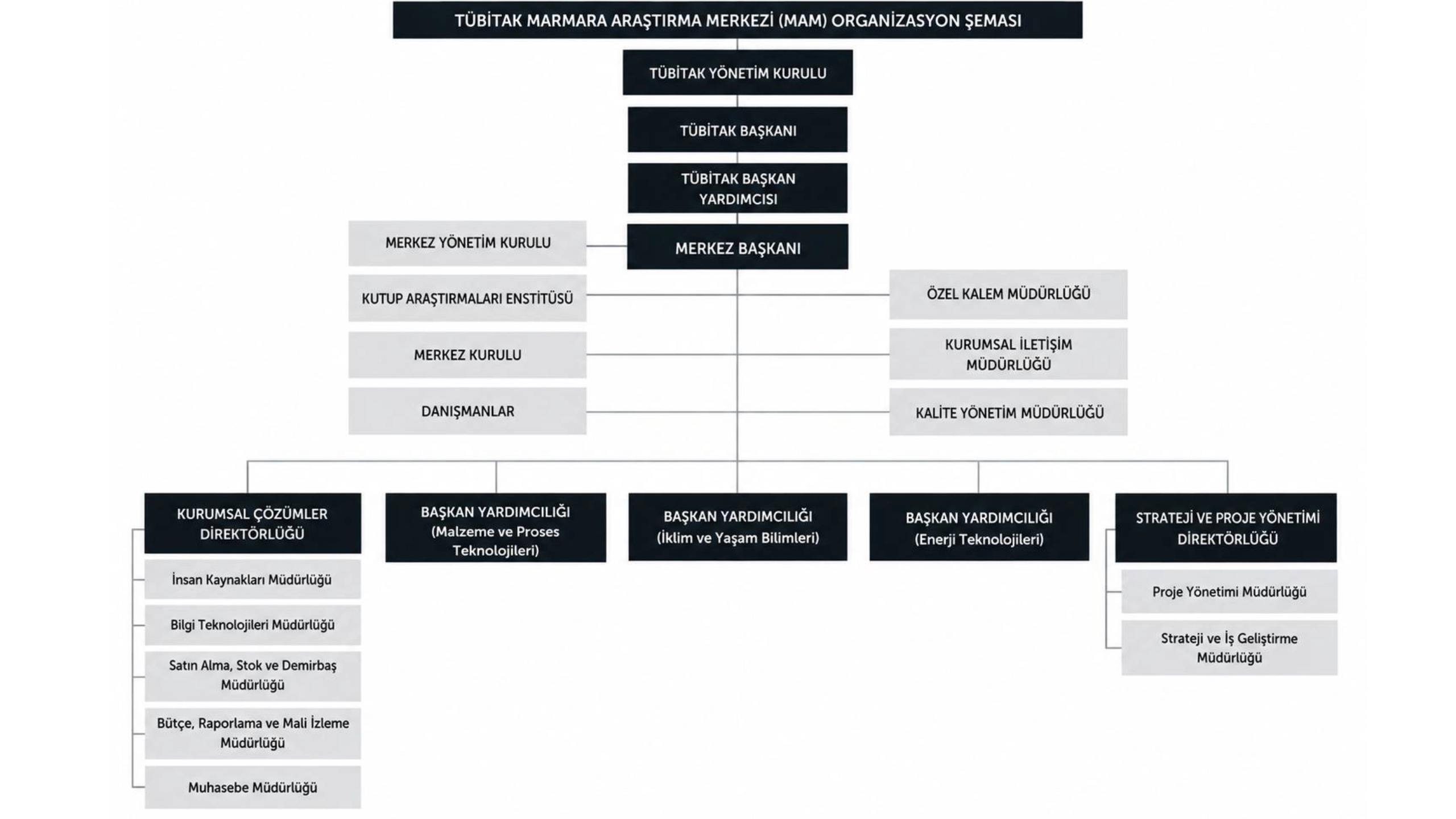
With the decision of TÜBİTAK Board of Directors, the MAM structure was reorganized; 16 research groups under 3 Vice Presidencies (Energy Technologies, Climate and Life Sciences, Materials and Process Technologies), 1 institute (KARE) and administrative units were structured under 2 directorates.
2021
With the decision of TÜBİTAK's Board of Directors, the MAM structure was reorganized; institutes were transformed into 23 research groups under 4 Vice Presidencies, while administrative units were gathered under 3 directorates.
2010-2019
In 2010, the Institute of Information Technologies was removed from MAM and affiliated to UEKAE. In 2013, the name of the Environment Institute was changed to the Environment and Clean Production Institute, and in 2015, the name of the Chemistry Institute was changed to the Chemical Technology Institute. During this period, MAM continued its activities with 7 institutes, and the Polar Research Institute (KARE) was established in 2019.
1995
The organizational structure has been constantly renewed according to the conditions and requirements of the day; research units with expanding staff and work volume have been transformed into separate institutes and some of them have been separated from MAM. In parallel with these developments, the Central Board of Directors was established.
1972
Work on the establishment of the Marmara Research Institute in Gebze was completed and the institute officially started its activities in its areas of specialization.
1963
TÜBİTAK was established at the beginning of the planned economy period in Turkey and its main tasks were to support basic and applied natural sciences research and to encourage young researchers.
2025
By 2025, TÜBİTAK MAM is playing an active role on the global science-technology scene with more than half a century of experience. This year, MAM is one of the partners of the BioINSouth Project funded by the European Union's CBE JU (Circular Biological Economy Joint Initiative). Within the scope of the project, the 1st BioINSouth Forum was held on June 5-6, 2025 in Catania, Italy and became the official partner event of the European Green Week 2025. In this forum, TÜBİTAK MAM experts shared their knowledge and experience with European stakeholders on the observance of ecological limits in regional bio-economy strategies. In 2025, MAM also carried out innovative projects at the intersection of artificial intelligence and advanced materials. The Institute of Materials initiated the design of new generation alloys using local artificial intelligence algorithms and crowned its first results with international patent applications. The Environment and Cleaner Production Institute, on the other hand, contributes to Turkey's transition to a circular economy by managing pilot city implementations in the UN-backed Zero Waste Cities initiative. Later in the year, MAM opened its advanced research infrastructure to start-up companies by commissioning the second phase of Teknopark. From 1972 to 2025, TÜBİTAK MAM continues to be the locomotive of Turkey's scientific development with its institute organizations, strategic projects, national-international collaborations and technological breakthroughs. With its professional, open and corporate vision, MAM will continue to support Turkey's global competitiveness with science and technology in the coming years.
2024
By 2025, TÜBİTAK MAM is playing an active role on the global science-technology scene with more than half a century of experience. This year, MAM is one of the partners of the BioINSouth Project funded by the European Union's CBE JU (Circular Biological Economy Joint Initiative). Within the scope of the project, the 1st BioINSouth Forum was held on June 5-6, 2025 in Catania, Italy and became the official partner event of the European Green Week 2025. In this forum, TÜBİTAK MAM experts shared their knowledge and experience with European stakeholders on the observance of ecological limits in regional bio-economy strategies. In 2025, MAM also carried out innovative projects at the intersection of artificial intelligence and advanced materials. The Institute of Materials initiated the design of new generation alloys using local artificial intelligence algorithms and crowned its first results with international patent applications. The Environment and Cleaner Production Institute, on the other hand, contributes to Turkey's transition to a circular economy by managing pilot city implementations in the UN-backed Zero Waste Cities initiative. Later in the year, MAM opened its advanced research infrastructure to start-up companies by commissioning the second phase of Teknopark. From 1972 to 2025, TÜBİTAK MAM continues to be the locomotive of Turkey's scientific development with its institute organizations, strategic projects, national-international collaborations and technological breakthroughs. With its professional, open and corporate vision, MAM will continue to support Turkey's global competitiveness with science and technology in the coming years.
2023
2023’te MAM, temiz enerji teknolojilerinde somut çıktılar elde etti. Hidrojen Teknolojileri Araştırma Grubu, Türkiye’nin ihtiyaç duyduğu yüksek kapasiteli elektrolizör geliştirme çalışmalarını tamamladı. Yıl sonunda Bandırma’daki Güney Marmara Hidrojen Vadisi Projesi kapsamında kullanılacak, ülkemizin ilk yerli proton değişim membran (PEM) elektrolizörü MAM tarafından üretildi. Bu elektrolizör ile %99,9 saflıkta hidrojen elde edilerek yeşil enerji hedeflerine katkı sağlandı. Sanayi ve Teknoloji Bakanı Mehmet Fatih Kacır, projeyi duyurarak “ilk yerli elektrolizörümüz TÜBİTAK enstitülerimizde üretildi” sözleriyle MAM’ın rolünü vurguladı. 2023 yılında MAM ayrıca Avrupa Birliği’nin UFUK2020/Horizon Europe programlarında birden çok projede konsorsiyum ortağı oldu. Özellikle biyo-temelli sanayi ve sürdürülebilirlik konulu Bio4Africa ve SuCCESS gibi projelerde MAM araştırmacıları, bilgi ve deneyimlerini uluslararası paydaşlarla paylaştı. Bu sayede MAM, Avrupa Yeşil Mutabakatı’nın hedeflerine katkı veren aktörlerden biri olarak konumunu güçlendirdi.
2022
TÜBİTAK MAM celebrated its 50th anniversary in 2022 with corporate events. MAM Strategic Plan 2022-2030 was published to carry its half-century of experience into the future. This plan emphasized climate-friendly technologies, digital transformation and innovation in health. To contribute to Turkey's Green Deal goals, MAM initiated carbon reduction in industry, circular economy and clean energy projects. For example, the energy institute embarked on R&D on boron-based battery technologies and carbon capture pilot plants, while the environment institute signed protocols with ministries to promote zero waste practices in industrial zones. The 50th anniversary events showcased MAM's historical achievements and promoted a culture of scientific excellence through project support competitions for young researchers.
2021
In 2021, TÜBİTAK MAM launched an important initiative in earthquake research. MAM's Marmara Research Ship realized the first earthquake research voyage in the Aegean Sea within the scope of the Turkey Earthquake Platform project. On May 31, 2021, the ship sailed from Kuşadası Bay and completed its mission in İzmir on June 13, 2021, collecting high-resolution data on the characteristics of faults on the seafloor. During this study, MAM became part of the national team that examined submarine faults in detail for the first time by conducting seafloor mapping, seismic measurements and sampling together with stakeholders such as ITU, Dokuz Eylül and Istanbul University. The data obtained was shared with AFAD to be used in the earthquake risk analysis of the Marmara Region. Furthermore, in 2021, MAM Energy Institute was involved in the "South Marmara Hydrogen Coast" project under the coordination of the Ministry of Industry and Technology in the field of hydrogen energy and undertook the task of developing green hydrogen production technologies.
2020
In 2020, MAM quickly took action against the COVID-19 pandemic affecting the whole world. With the support of the East Marmara Development Agency, the establishment of the Protective Textile Testing Center (KOTTEM) within the MAM Materials Institute was completed. This center played a critical role in the fight against the pandemic by starting the analysis of respiratory masks and protective medical textiles. At KOTTEM, tests such as respiratory resistance and filter efficiency started to be carried out at international standards. In addition, MAM Gene Engineering Institute conducted validation studies of domestic PCR diagnostic kits and contributed to the laboratory-scale production of vaccine candidate proteins. In 2020, MAM continued many of its critical projects without interruption as it switched to remote working and responded to social needs by providing test/control services to health institutions.
2019
With the decision of TÜBİTAK Board of Directors on December 24, 2019, the Polar Research Institute (KARE) was officially established under MAM. This institute has become the national focal point for Turkey's scientific work in the polar regions. The 3rd National Antarctic Science Expedition and the first Arctic Science Expedition organized in 2019 started to be transferred from ITU PolReC coordination to MAM KARE. In this way, all polar expeditions have been continued regularly by MAM KARE since the end of 2019. Also in 2019, MAM Energy Institute completed prototype production in the domestic lithium battery cell development project and tested Turkey's first domestic battery cells. The Institute of Chemical Technology also made significant progress on hydrogen storage technologies from boron products in cooperation with Eti Maden.
2018
In 2018, MAM's marine research capacity was maximized. Throughout the year, TÜBİTAK Marmara Research Ship made numerous voyages in the Black Sea, Marmara and Aegean Seas, conducting water quality monitoring, marine ecosystem mapping and seabed mineral surveys. With the support of the MAM Environment and Cleaner Production Institute, the data obtained from the ship was used to prevent marine pollution and identify new protection zones. Also in 2018, work on the establishment of the Polar Research Institute (KARE) was completed, pending the decision of the TÜBİTAK Board of Directors. MAM Materials Institute, on the other hand, established the infrastructure of the Protective Textile Test Center project with the East Marmara Development Agency and completed the preparations for the center to be opened in 2019.
2017
2017 marked a turning point in Turkey's polar research. The First National Antarctic Science Expedition (TAE-I) was organized under the auspices of the Presidency and under the coordination of the Ministry of Industry and Technology. TÜBİTAK MAM researchers participated in this expedition together with ITU PolReC and conducted scientific studies in Antarctica. Our flag was flown over the Antarctic continent for the first time during this expedition. Upon the return of the expedition, MAM contributed to the preparation of the National Polar Science Program (2018-2022) with the data obtained. This success showed that MAM has started to lead the country in polar sciences. In the same year, MAM signed a joint R&D agreement with ASPİLSAN for the production of lithium-ion batteries in energy technologies, and started the process of developing domestic batteries for defense and civilian use.
2016
In 2016, MAM launched R&D on global agenda items such as climate change and smart cities. A specialized unit on climate modeling and carbon mitigation techniques was established under the Vice Presidency of Climate Change and Sustainability. In addition, with the support of the East Marmara Development Agency, the project to establish a Protective Textile Test Center (KOTTEM) at MAM was initiated (to create a testing infrastructure for masks and protective clothing). In addition, MAM Life Sciences unit started to play an active role in health innovations by opening new laboratories for CRISPR gene editing technologies and cancer research.
2015
In 2015, TÜBİTAK Science Council revised the names of some institutes within MAM. On June 6, 2015, the name of the Institute of Chemistry was changed to the Institute of Chemical Technology. This change reflected a shift in the institute's focus towards applied chemical process technologies. Similarly, the Institute of Materials expanded its scope of activities to include emerging materials sciences and began to emphasize "Materials Technologies". This year, MAM collaborated with regional development agencies to expand industrial efficiency-enhancing "clean production" projects in Kocaeli and neighboring provinces.
2014
In 2014, MAM prepared for the transition to the "Vice Presidencies" model in its administrative structure in line with TÜBİTAK's strategic goals. Institutes started to be grouped under relevant thematic vice presidencies (Energy, Materials, Climate and Life Technologies, etc.). This year, MAM also prioritized projects focused on sustainable development. For example, large-scale projects were launched in the fields of converting urban waste into energy, clean water technologies and agricultural biotechnology. These projects emphasized MAM's mission to contribute to environmental and economic sustainability.
2013
In 2013, TÜBİTAK MAM's 41.2-meter research vessel R/V TÜBİTAK MARMARA was built and commissioned. This regional class oceanography vessel started a new era in marine research by embarking on its maiden voyage on July 1, 2013. With the ship's advanced equipment, pollution monitoring, marine geology and biodiversity research began to be conducted in Turkey's seas. Another important development in 2013 was the expansion of the structure of the MAM Environment Institute by a decision of the Scientific Council of TÜBİTAK. On April 6, 2013, the MAM Environment Institute was restructured to function as a national Cleaner Production Center and renamed the Environment and Cleaner Production Institute. In this way, MAM became a nationwide competent center in sustainable production technologies.
2012
In 2012, with Turkey's growing interest in the polar regions, preparations for polar research began at MAM. In particular, researchers from the marine science and climate institutes developed trainings and project proposals on Antarctica and the Arctic. MAM contributed to the Polar Research Program established under the umbrella of TÜBİTAK and provided scientific support to the plans for the first Turkish polar science expedition. Also this year, MAM started new R&D collaborations with the Ministry of Industry and Technology on clean energy technologies (solar, wind, hydrogen).
2011
In 2011, MAM started to specialize in Climate Change due to its increasing global importance. A climate change and air quality research group was established under the Environment Institute, providing scientific support to national climate policy studies. In the same year, MAM Food Institute received international accreditation, bringing its food analysis laboratories up to world standards. The Energy Institute also successfully tested Turkey's first indigenous fuel cell prototypes this year. These developments show that MAM continues its progress focused on deepening expertise and quality in every field. showed.
2010
In 2010, TÜBİTAK established BİLGEM (Informatics and Information Security Advanced Technologies Research Center) to gather its institutes in the field of informatics and information security under a single roof. In this context, the Information Technologies Institute (BTE) of MAM merged with UEKAE and came together under the umbrella of TÜBİTAK BİLGEM. As a result of this reorganization, an R&D structure of approximately 1,200 people was created and MAM transferred its activities in the field of informatics to BİLGEM. MAM, on the other hand, redefined its focus areas as energy, materials, environment, food, biotechnology and earth sciences.
2009
In 2009, MAM stood out in Turkey's science and technology ecosystem with its projects. MAM researchers won awards in multiple categories at that year's TÜBİTAK Science and Technology Awards for their innovative products. For example, the boron-doped superconductor development project in the field of materials and the domestic lithium-ion battery prototype in the field of energy were the works that brought MAM awards. The institution also ranked first within TÜBİTAK in terms of patent commercialization performance, demonstrating its success in transforming R&D into products.
2008
In 2008, MAM won its first coordinated project under the European Union 7th Framework Program. Through this project, MAM coordinated the development of an innovative environmental technology by managing consortium partners in Europe. Also this year, the New Materials Research Center building was completed on the MAM campus. Built for advanced materials synthesis and characterization, this facility houses more than 50 laboratories, pilot production lines and clean rooms. With this infrastructure investment, MAM has become the region's most comprehensive applied research base.
2007
In 2007, MAM Materials Institute developed armor materials and blast-absorbing composites in cooperation with the Ministry of National Defence. The prototypes produced within the scope of these studies were tested on armored vehicles and achieved success. The Energy Institute, on the other hand, took part in joint defense electronics projects with organizations such as TAI and ASELSAN. Meanwhile, the Food Institute developed standards for product shelf life extension and food safety tests to increase the competitiveness of the Turkish food industry.
2006
In 2006, MAM updated its institute organization. Due to the increasing volume of projects, the Institute of Materials and Chemical Technologies was divided into sub-units, some of which are now managed independently as the Institute of Materials and the Institute of Chemistry. Similarly, the Institute for Energy Systems and Environmental Research was divided into two separate focus areas: energy and environment. In this way, each institute gained more depth by concentrating more on its own area of specialization. In addition, 2006 was a year in which MAM received infrastructure support from TÜBİTAK in line with its "Center of Excellence" vision.
2005
In 2005, MAM strengthened its Project Management Office structure to increase efficiency in project management. In order to maximize the contribution of ongoing R&D projects to the national economy, support programs were initiated for researchers in the commercialization of results and patent applications. This year, MAM started to transfer the cleaner production methods developed in the field of environmental technologies to industrial organizations; the first cleaner production training seminar was organized for SMEs and MAM's know-how was disseminated.
2004
In 2004, TÜBİTAK reviewed the structure of its research centers. In this context, the Turkish Industry Transfer and Administration Institute (TÜSSİDE), which had been operating under MAM, was separated from MAM and transformed into an institute directly affiliated to the TÜBİTAK Presidency. As a result, MAM concentrated more on its focus areas and adopted a leaner and project-based model in its management and organizational structure. In the same year, MAM adopted policies that encourage innovative and entrepreneurial approaches in its corporate culture.
2003
In 2003, TÜBİTAK MAM's Gene Engineering Institute became an affiliate center of the United Nations ICGEB. In this context, MAM hosted scientists from abroad and organized joint workshops and courses on advanced biotechnology. In 2003, MAM hosted a consortium meeting for one of the European Union's 6th Framework Program projects, strengthening the center's position on the international R&D scene. Research and Technology Development Protocols were signed between MAM and domestic universities.
2002
As MAM celebrated its 30th anniversary in 2002, it announced several critical R&D achievements. MAM researchers succeeded in developing and producing detectors that detect letters containing anthrax germs. In addition, special protective suits that provide full protection against nuclear warfare were made available for the Turkish Armed Forces. A new superalloy, developed in collaboration with industry for the Ereğli Iron and Steel plants, increases the lifespan of rails used to transport hot steel masses from four to 28 months. The Food Institute developed "edible" packaging and food products that can last two years at room temperature without spoiling. Also during this period, Turkey's first fuel cell pilot production facility was established.
2001
In 2001, MAM started to work in line with the biosecurity concerns that emerged after September 11. In particular, R&D projects were initiated on detection technologies against chemical and biological threats. During this period, MAM Materials Institute completed the development of detector devices that detect anthrax (anthrax) spores. At the same time, research on nuclear-biological-chemical (NBC) protective materials accelerated in chemical technologies laboratories. These preparations demonstrated MAM's ability to produce technologies for national security, and laid the foundation for important products that will be realized in 2002.
2000
In 2000, TÜBİTAK MAM signed a contract with the Undersecretariat of Foreign Trade and officially started the establishment and operation of TEKSEB. MAM was authorized to manage Turkey's first and only technology free zone with the status of Zone Founder and Operator. As a result, local and foreign R&D companies began to be attracted to the technopark area on the Gebze campus. TEKSEB provided companies with laboratory infrastructure, expert support and a researcher ecosystem thanks to its location within the research center. This year, MAM also played a critical role in responding to the global Y2K (Year 2000) problem by testing the technological infrastructures of public institutions and providing consultancy.
1999
In 1999, the location and boundaries of the TÜBİTAK MAM Technology Free Zone (TEKSEB) were determined by a decision of the Council of Ministers. Thus, the technopark area in the Gebze campus gained "free zone" status and became the only applied research free zone in Turkey, offering tax and incentive advantages to R&D companies. 1999 was also the year of the great Marmara Earthquake. In the aftermath of the earthquake, TÜBİTAK MAM established intensive seismology and GPS networks in the region and conducted aftershock observations. MAM Earth Sciences Group contributed to a better understanding of earthquakes by monitoring before and after the earthquake and sharing the data obtained with relevant institutions. These studies showed that MAM plays a critical role in disaster research.
1998
In 1998, the National Electronics and Cryptology Research Institute (UEKAE) under TÜBİTAK was separated from MAM and directly affiliated to TÜBİTAK Presidency. Thus, informatics and electronic security activities at MAM began to continue under the roof of a separate institute. In the same year, MAM launched Turkey's first Technopark initiative. The MAM Technopark Project was approved by KOSGEB and the establishment of a technology development zone on the MAM campus became official. With this development, the technopark created within TÜBİTAK MAM was declared as Turkey's first technopark. This technopark was an important step towards the commercialization of research results.
1997
MAM celebrated its 25th anniversary in 1997. With the "1972-1997 25th Anniversary Book" published on this occasion, the Center's quarter-century achievements were shared with the public. As a milestone, some of MAM's units were restructured. For example, sub-research groups were established within the Institute of Materials and Chemical Technologies (MKTAE), increasing specialization in defence materials and civil industry materials. MAM's future strategy was updated this year in light of past project experiences.
1996
In 1996, MAM began to take an active role in international R&D projects, particularly in the European Union Framework Programs. The Institute participated in the first EU-funded projects in the fields of energy and environment and established consortia with foreign partners. This year, MAM also contributed to the IT infrastructure by providing technical support for the establishment of ULAKBIM, TÜBİTAK's nationwide academic internet network.
1995
In 1995, the Information Technologies Research Institute (ITRI) was established and became operational within MAM. This institute has enabled MAM to have a voice in the field of digital technologies by conducting R&D in advanced electronics, communications and information security. Also in 1995, MAM's quality management system certification process was completed and ISO 9001 certification was obtained. This development confirmed the compliance of MAM's institutional structure with international standards.
1994
In 1994, MAM initiated processes to comply with international standards to ensure quality in research activities. Researchers were trained on the standardization and patentability of R&D outputs. This year, MAM also began preparations to establish the TS-EN ISO 9001 Quality Management System, the first of its kind among research centers in Turkey.
1993
In 1993, MAM invested in new laboratory buildings and facilities at its Gebze campus. The central research laboratory was expanded to accommodate a larger number of projects. In particular, advanced materials analysis laboratories (X-ray, electron microscopy, spectral analysis, etc.) were equipped with modern equipment during this period. In this way, the capacity and reliability of the testing and analysis services provided by MAM to industry have increased.
1992
In 1992, TÜBİTAK MAM established a Technology Development Center to support companies that wanted to transform their R&D results into economic value. This center served as an incubator for the sprouting of new R&D-oriented companies on the MAM campus. This step led to the birth of the idea of a technopark in Turkey. In the same year, MAM began working more closely with the private sector by increasing the number of projects carried out jointly with industry.
1991
In 1991, MAM entered defense and space technology projects with the opportunities brought by the post-Cold War era. R&D activities intensified in areas such as rocket fuels, radar absorbing materials and communication systems. At the same time, the institute's Food Institute produced significant outputs in the areas of long shelf-stable nutrients and edible packaging, bringing innovation to both the military rations and civilian food sectors.
1990
In 1990, MAM further clarified its institutional structure around seven separate institutes. Materials-Chemistry, Energy, Food, Food, Environment, Earth and Marine Sciences, Biotechnology, and Informatics institutes. Also this year, MAM started to implement quality systems in its laboratories. The first internal audits and training programs aimed to ensure that research processes comply with international standards.
1989
Turkey became a member of the International Center for Gene Engineering and Biotechnology (ICGEB) in 1989. With this membership, MAM's Institute of Gene Engineering was assigned as ICGEB's Affiliated Center in Turkey. Thus, MAM gained access to international knowledge and technologies in the field of molecular biology and genetics, and paved the way for Turkish researchers to benefit from ICGEB scholarship and project opportunities. This development enabled MAM to integrate into global collaborations in the fields of health and biotechnology.
1988
In 1988, MAM continued its efforts to integrate into international scientific networks. The Institute applied for participation in various projects within the framework of the United Nations and the European Community. Joint project agreements were signed with foreign research centers, especially in the fields of climate change and marine sciences, and knowledge transfer was ensured. This year, MAM researchers made presentations representing Turkey at international scientific congresses for the first time.
1987
In 1987, MAM started to develop technologies to reduce the environmental impact of industrialization. R&D projects on water and air pollution monitoring systems, wastewater treatment pilot plants and clean production methods intensified during this period. MAM's environmental scientists prepared comprehensive reports on Marmara Sea pollution, providing decision-makers with scientific data and, for the first time, technical contributions to national environmental policies.
1986
In 1986, MAM's work in the field of energy technologies was organized under the umbrella of an institute. The Energy Systems Research Unit, which would later become an institute, was organized to accelerate the development of indigenous energy technologies (e.g. solar energy applications, fuels and batteries). This year, MAM also entered the field of renewable energy by launching a project to produce Turkey's first solar panel prototypes.
1985
In 1985, MAM Materials and Chemistry researchers focused on the development of critical materials for the defense industry. In this context, projects were carried out on composite armor materials, high temperature resistant ceramics and special alloys. In addition, the first steps were taken to reduce Turkey's foreign dependence by working on the production of domestic materials used in electronic and communication devices.
1984
In 1984, the National Metrology Institute (UME) was established in TÜBİTAK Gebze Campus and the field of measurement sciences was shaped as a separate organization from MAM. With this development, MAM deepened its research in chemistry, materials, energy, environment and biotechnology by concentrating on focus areas other than metrology. In the same year, MAM began working in coordination with UME in calibration and testing services for Turkey's industrial organizations.
1983
In 1983, the Institute of Gene Engineering and Biotechnology (GMBE) was established within TÜBİTAK MAM. GMBE, which was established to conduct research in advanced molecular biology and genetics, became the pioneer of modern biotechnology studies in Turkey. With the establishment of this institute, important R&D projects were initiated in the fields of health, agriculture and environmental biotechnology.
1982
This year, MAM's management structure was updated. In order to strengthen coordination with TÜBİTAK headquarters, administrative processes were improved and R&D programs were made more planned. In addition, programs for researcher training and in-house technology transfer were initiated, reinforcing MAM's corporate culture around the mission of "serving Turkey with science and technology".
1981
In 1981, concrete outputs started to be obtained from the projects carried out at MAM. Domestic patent applications were filed for some innovative materials and devices developed by the Institute's researchers. In particular, an anti-corrosion coating developed by the chemistry institute and long-lasting food additives formulated by the food institute were introduced to the industry, demonstrating MAM's innovation capacity.
1980
In 1980, the institute updated its research strategy to respond to the country's changing needs. Defense technologies, petrochemicals and food security were included among the strategic priorities. Accordingly, MAM researchers initiated R&D projects to develop indigenous electronic devices, produce high-strength materials and agricultural product processing technologies.
1979
This year, MAM established contacts and exchanged information with foreign research organizations for the first time. Steps were taken to participate in international projects, especially in the fields of marine sciences and environment. In this context, joint studies were carried out with scientists from neighboring countries on the pollution status and marine ecosystem of the Marmara Sea.
1978
In 1978, MAM began to focus on projects in the fields of environment and energy. Waste water treatment and air quality monitoring studies were carried out to solve the environmental problems that emerged during Turkey's industrialization process. In the field of energy, research was initiated on the utilization of domestic resources, clean use of coal and energy efficiency, and knowledge was accumulated in strategic areas.
1977
In 1977, MAM made significant investments in its laboratory infrastructure. New spectrometers, microscopes and pilot-scale experimental setups were installed. Especially with the strengthening of the materials testing laboratories, the capacity for analysis and inspection services for industry increased. During this period, the institution became a center capable of performing some advanced materials analyses for the first time in Turkey and became the R&D partner of many industrial organizations.
1976
This year, MAM has become more specialized by dividing its activities into thematic institute units. Materials, Chemistry, Food and Environment research units were established, enabling each unit to develop projects in its own area of specialization. Thus, research began to be coordinated more efficiently and focused on national priorities.
1975
MAM launched its first R&D initiatives for the defense industry in 1975. Research on materials development, ballistic protection and electronic systems were conducted for the Turkish Armed Forces. In cooperation with the private sector, projects were carried out to improve product quality in the fields of automotive and metallurgy, and the first examples of industry-research cooperation were exhibited in Turkey.
1974
In 1974, MAM expanded its research buildings on the Gebze campus. With the participation of new researchers, MAM expanded its staff and developed projects to meet the needs of the country, especially in the fields of chemistry and materials technologies. During this period, the institute laid the foundations of corporate collaborations by signing joint projects with public institutions and industrial organizations.
1973
The newly established Marmara Research Institute started its research activities at full capacity in 1973 by completing its basic laboratory infrastructure. The first R&D projects in areas such as chemistry, materials, environment and food were realized in this year. The Institute started to offer the first consultancy and testing services in cooperation with industry, and took on the task of contributing to Turkey's technological development.
1972
TÜBİTAK Marmara Research Center (MAM) was established in Gebze under the name Marmara Scientific and Industrial Research Institute. Under the leadership of its first director Prof. Dr. Mehmet Nimet Özdaş, a research campus was established. In addition, the Electronics Research Unit (ERU) was moved from Ankara to Gebze and started working within MAM. These steps enabled TÜBİTAK to realize its applied research goals in the Marmara Region.