"Integrated Marine Pollution Monitoring Project" will be carried out by TÜBİTAK-Marmara Research Center, Environment and Cleaner Production Institute.
"Integrated Marine Pollution Monitoring Project", supported by the Ministry of Environment and Urbanization, will be carried out by TÜBİTAK-Marmara Research Center (TÜBİTAK MAM), Environment and Cleaner Production Institute for 3 years in the marine and coastal waters of our country.
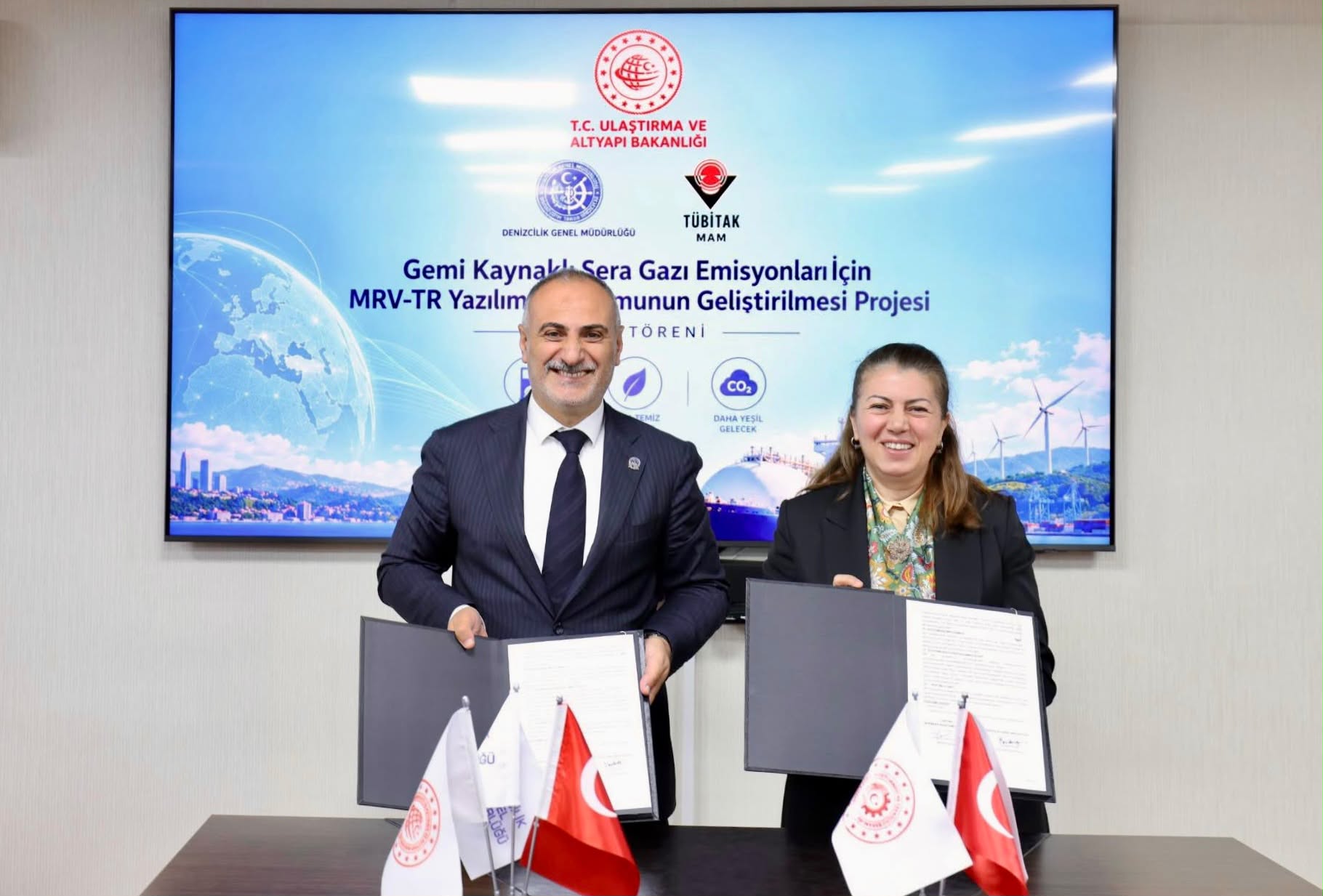
The project contract was signed by M. Mustafa SATILMIŞ, Director General of EIA, Permit and Inspection and Dr. Orkun HASEKİOĞLU, President of TÜBİTAK MAM on 15 March 2017 at the Ministry of Environment and Urbanization. During the signing ceremony, Dr. Selma Ayaz, Director of TÜBİTAK MAM Environment and Cleaner Production Institute, Hakan Atabay, Project Manager and Soner OLGUN, Head of Laboratory, Measurement and Monitoring Department of the Directorate General of EIA, Permit and Inspection of the MoEU and his team gave information about the project.
Monitoring will be carried out in coastal and estuarine waters and offshore stations in the Black Sea, Marmara Sea and Straits, Mediterranean and Aegean Sea. The studies will be carried out through TÜBİTAK Marmara Research Ship and in cooperation with universities and other research institutions. The marine studies to be carried out are planned as 3 periods in the Marmara Sea and 2 periods per year in other seas, and offshore waters will be included in the studies at a higher rate compared to the previous period (2014-2016). In this context, monitoring activities will be increased especially in the Black Sea, where we have a wide jurisdiction.
With the "Integrated Marine Pollution Monitoring (and Assessment) Project", the physicochemical properties of Turkey's seas and coastal waters, components and indicators reflecting their ecological status, pollution status, radioactivity levels, solid wastes accumulated on the coast and in the sea, seagrass meadows, seafloor biodiversity and target species for economic fisheries and their pollutant levels will be monitored. With the results obtained, quality classification will be made and the status of coastal water bodies and marine areas will be assessed.
In this context, in addition to the point water column studies planned to be carried out at approximately 300 stations, a total of 56 macro flora, 80 trawl biodiversity (fish) and solid waste, 2 commercial species of fish at 40 trawl stations and also pollutants at 5 mussel stations, 2 seagrass meadows, 4 coastal solid waste studies will be carried out. In addition to biological components, 60 macrozoobenthos, 95/40 phyto/zooplankton studies will be carried out. Levels of common pollutants will be determined at a total of 100 sediment stations and comparisons will be made with previous years. Monitoring of radioactivity levels in sediment and water samples will continue at 20 stations in the seas of Turkey. Microplastic studies will continue with pilot studies as in the 2014-2016 period.
Within the scope of the project, it is aimed to establish pilot-scale systems where real-time water quality and hydrodynamic properties can be monitored with marine buoys, and to carry out feasibility studies and report them. In addition, it is aimed to use the data and images provided by existing satellites for marine monitoring and assessment, and to determine and evaluate the eutrophication status of our seas with new computer software such as BEAST/HEAT. In addition, studies will be carried out in which pressures and impacts will be evaluated together in terms of the management of coastal water bodies.
The project aims to monitor the physical and chemical characteristics, pollution and ecological status of our seas and to make knowledge-based assessments for the determination of national marine management policies and strategies. As a result of these studies, environmental status reports will be prepared for the seas.
In 2017, regional workshops will be organized in Marmara, 2018 in Black Sea and 2019 in Mediterranean & Aegean Sea regions. In the workshops, the results of monitoring studies and marine pressures will be shared with public institutions, universities, non-governmental organizations, municipalities and other relevant stakeholders who are the beneficiaries and stakeholders of the seas in the regions. At the end of the project, "2nd National Marine Monitoring and Assessment Symposium" will be organized.
The relevant Ministry publication is available below.
http://www.csb.gov.tr/projeler/lab/index.php?Sayfa=haberdetay&Id=107356