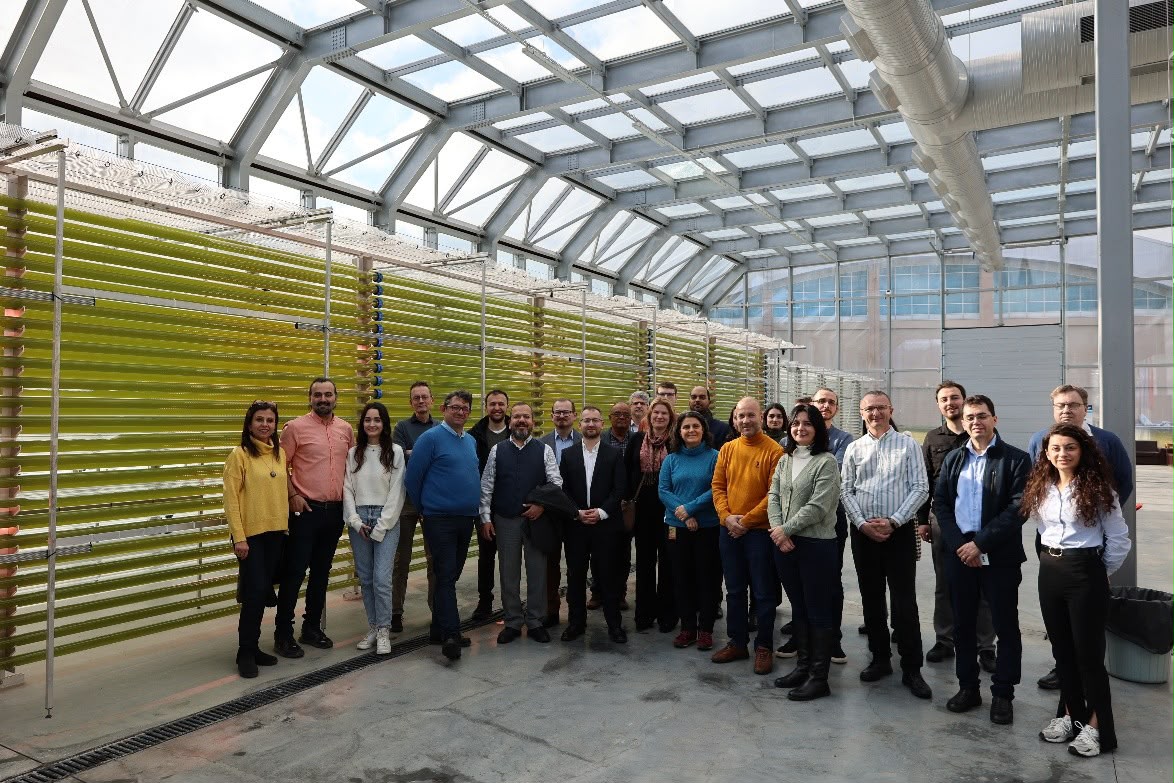
The science team participating in the 4th Arctic Scientific Research Expedition, organized under the auspices of the Presidency, under the auspices of the Ministry of Industry and Technology and under the coordination of the TÜBİTAK MAM Polar Research Institute, is carrying out studies on 16 projects in the marine area in the Arctic region.
The team includes participants from TÜBİTAK, the Directorate of Navigation Hydrography and Oceanography, the General Directorate of Meteorology, Anadolu Agency, Istanbul University, Istanbul Technical University, Karadeniz Technical University and Dokuz Eylül University, as well as two guest researchers from Bulgaria and Chile within the scope of bilateral collaborations.
Leader of the 4th National Arctic Scientific Research Expedition Prof. Dr. Ersan Başar is looking for the answer to the question of what changes in the health and dynamics of the ecosystem in the Barents Sea with "Investigation of the Plankton and Pigment Composition of the Barents Sea during the Arctic Summer 2024", one of the 16 projects carried out during the expedition.
Deputy Leader Captain Doğaç Baybars Işıler is also working on "how navigation and life safety can be improved in polar regions" while carrying out logistical operations related to the execution of the expedition.
Expedition participant Senior Photojournalist Şebnem Coşkun, on the other hand, aims to announce the outputs of Turkey's scientific expeditions to the polar regions to the whole world with the scientific studies carried out during the expeditions, photography, video and news projects on the effects of global climate change and living life.
Expeditionary work;
Çetin Biçer, Engineer of the General Directorate of Meteorology, aims to measure and record air temperature, humidity, wind direction and speed, air pressure, sea water temperature, global insolation intensity, position values with high accuracy according to WMO standards with certified sensors in this region with the project "Collection of marine meteorology data in the Arctic region".
Engineer Lieutenant Kunter İncili, Oceanography Officer of the Department of Navigation, Hydrography and Oceanography (Dz.K.K.), is looking for the answer to the question "What will be the effect of glacier melting on the current system in the Barents Sea and around Svalbard" with "Dynamics of Arctic layers and thermocline and halocline studies around Svalbard".
Dr. Aslıhan Nasıf Dondurur from Dokuz Eylül University is investigating "the presence of freshwater inflows in the seas around the Svalbard Islands as a result of glacial melt and their relationship with ocean currents" with the Shallow Marine Oceanography of the Svalbard Region.
Nursu Aylin Kasa from Istanbul Medipol University is working on "Determination of pharmaceutical active ingredients and metabolites with high accuracy and sensitivity in environmental samples in the Arctic region using LC-MS/MS combined with next-generation precursor methods" and "Is it possible to detect frequently used pharmaceutical active ingredients and their residues at trace levels in the Barents Sea?".
Bilge Durgut from Middle East Technical University, on the other hand, seeks the answer to the question "How is biodiversity changing in different regions of the Barents Sea?" with "Determination of Spatial Change of Arctic Biodiversity by eDNA Metabarcoding and Evaluation with Physicochemical Parameters".
Gülden Açıl from Istanbul Technical University is working on "Detection of antifouling compounds in the aquatic environment" and the question "How does the detection of these compounds in the Barents Sea affect the health and biodiversity of the marine ecosystem?".
Maria Jose Narino Vargas from the Chilean Antarctic Institute, with her project "Phytoplankton in a Changing Ocean", "Is phytoplankton changing its structure in terms of composition and abundance, introducing new species for the Arctic Ocean? Can these new species be considered toxic?", and expedition participant Dr. Petar Sapundjiev from the Bulgarian Antarctic Institute, with his project "Developing technical solutions for observing variability of cosmic radiation in the polar regions". Petar Sapundjiev from the Bulgarian Antarctic Institute, and Dr. Petar Sapundjiev from the Bulgarian Antarctic Institute, participant of the expedition, in his project "Development of technical solutions for the observation of variability of cosmic radiation in the polar regions" and "How can we increase the reliability and functionality of our field-deployed scientific equipment in the harsh environment of the polar regions?".
The expedition team is expected to return to Turkey next week.